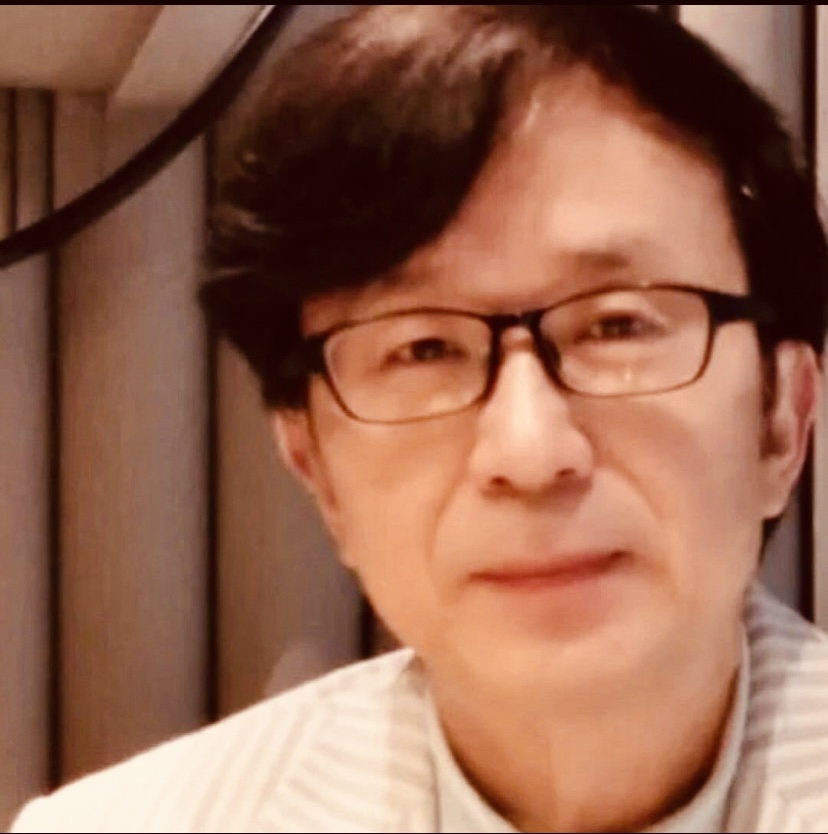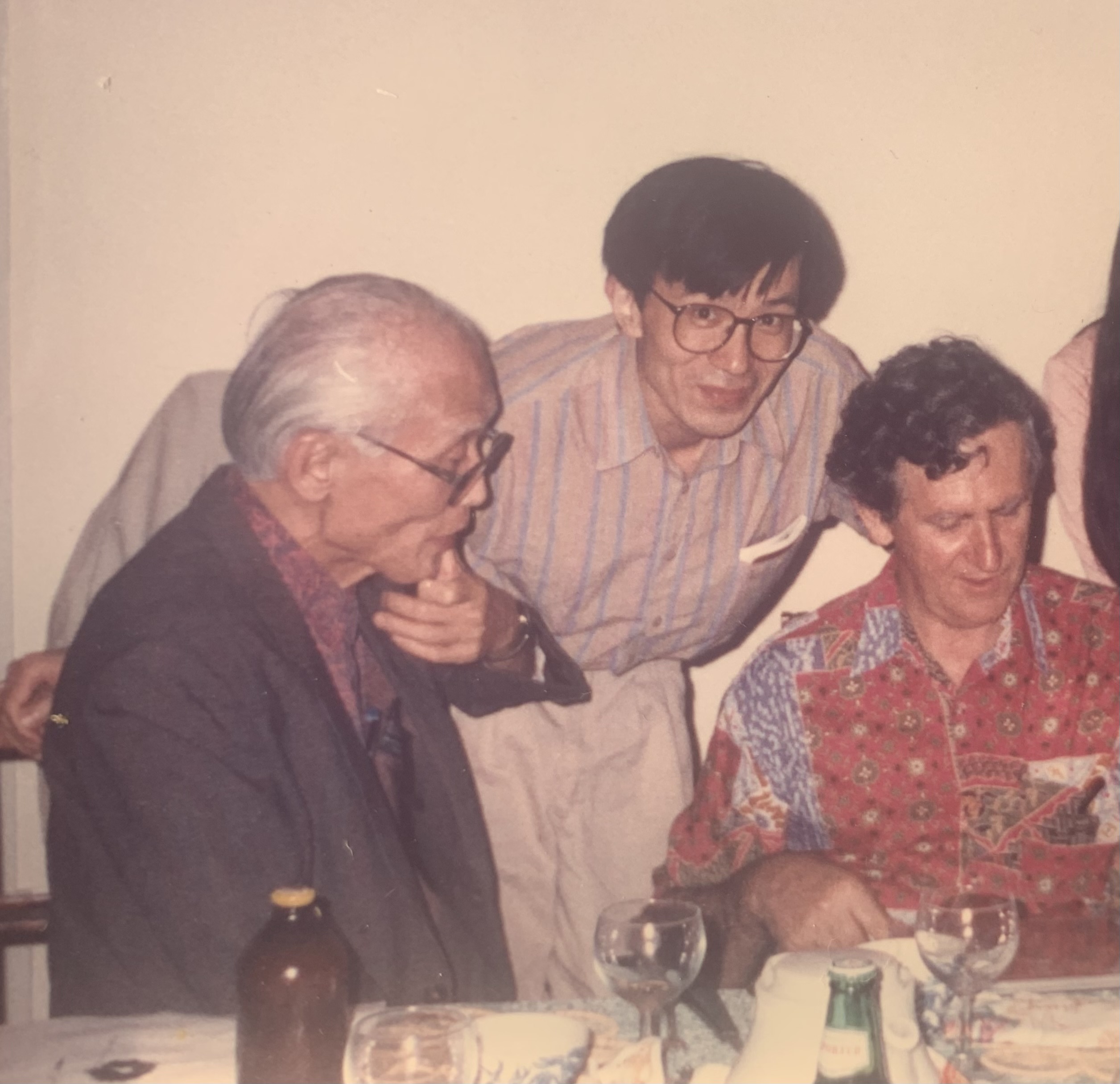
年轻时的巢圣和余光中教授在前澳大利亚作家协会主席Glen Philips 教授家相遇相识。余教授评论巢圣的英语诗集说,“这是汉语诗歌的损失,却是中国人的骄傲。”
《余光中:语言的考古学家》(朗诵视频制作版)
【序章:邮票的背面】
他从一枚邮票开始。
不是正面——那太像宣传了——
是背面,浆糊的遗迹,
纤维的暴力,
和一枚齿孔
完美的
缺席。
那是1971年。他三十三岁,
已经学会了
在中文里
埋葬自己。
"乡愁是一枚小小的邮票",
他写道,然后
立刻后悔——
"小小"是多余的,
"一枚"也是。
但已经
印出来了,
在无数课本上,
成为
他无法收回的
public
遗嘱。
【第一章:考古现场】
现在他老了,八十九岁,
仍然在挖。
不是土,是
语言。是"听听那冷雨"
里,"听听"的
叠字陷阱——
第一个"听"是动词,
第二个是
叹息。他挖了六十年,
才确认这个。
他的书房是
一个分层遗址:
上层,英文诗稿,
1950年代的
早熟;
中层,白话文运动
的残余,
胡适的幽灵
偶尔来访;
最深处,是《诗经》,
是楚辞,
是未被白话
污染的
韵脚。
他从不使用
"挖掘机"——
那种暴力的
现代性。
他只用手,
指甲,和
一种顽固的
耐心。因此
他的发现
总是
带血:
"蓝墨水的上游
是汨罗江"——
这个句子,
他挖了
四十年,
指甲缝里
至今有
屈原的
泥。
【第二章:方言的幽灵】
他的普通话里有
ghost。
不是闽南语——
那太明显了——
是更古老的:
客家话的
入声,
在"国家"的"国"字上
突然
短促,
像被
剪断的
呼吸。
他试图驱除
这些幽灵。
1950年代,
在台北的
广播里,
他练习
标准的
四声,
像练习
一种
正确的
遗忘。
但幽灵
拒绝离开。
它们在深夜
回来,
在他的
梦里,
用他母亲的
口音,
朗读他
自己的
诗——
那些诗
突然
变得
陌生,
像从
土里
刚挖出来的,
还带着
潮湿的
错误。
【第三章:翻译的背叛】
他翻译过
《梵谷传》,
把Van Gogh
变成
"梵谷"——
不是"梵高",
不是"凡高",
是"梵谷",
带有一种
佛教的
回响,
和山谷的
空旷。
这是他的
典型
手法:
把西方
埋进
东方,
让翻译
成为
一种
缓慢的
占领。
但他知道
这是
背叛——
对原文的,
对他自己的
语言的。
每次翻译,
他都感到
一种
分裂:
英文的
他
在左边,
中文的
他
在右边,
中间
是
一片
无法翻译的
黑暗,
那里
住着
真正的
他,
沉默如
一枚
未使用的
邮票。
【第四章:最后的挖掘】
2017年。
他最后的
诗,
关于
死亡,
但从不
使用
那个
字。
他写:
"当我死时,
葬我,
在长江与黄河
之间"——
注意
那个
逗号,
在"葬我"
之后,
那是
呼吸的
停顿,
是
尚未
完成的
生命。
他现在
躺在那里了,
在高雄,
不是
长江与黄河
之间,
是
太平洋的
边缘,
一座
岛屿的
边缘,
一种
永恒的
偏离。
但他的
语言
还在
被挖掘。
学生们
在课本里
背诵
"听听那冷雨",
不知道
第二个"听"
是
叹息。
邮递员
仍然
投递
那枚
小小的
乡愁,
尽管
收件人
已经
不在
原址。
【终章:语言的考古学家】
因此
他最终
成为
他研究的
对象:
一个
用中文
埋葬自己的
样本,
一个
证明
语言
比肉体
更
漫长的
证据。
他的
书房
现在是
纪念馆,
玻璃
罩住
一切:
诗稿,
邮票,
指甲缝里的
汨罗江
泥。
导游
用
扩音器
讲解,
声音
在
"蓝墨水"的
"蓝"字上
产生
轻微的
反馈
啸叫——
那是
他的
幽灵,
在
纠正
发音,
或者
只是
在
提醒我们:
所有
被
说出的,
都
需要
被
重新
挖掘。
而
我们,
站在
玻璃
外面,
看着
他的
遗物,
突然
意识到
自己
也是
遗址,
也是
未来
某个
考古学家
将要
面对的
沉默,
和
那沉默
中,
无法
被
邮递的,
无法
被
翻译的,
无法
被
埋葬的,
乡愁。
选自巢圣诗集《流浪的月亮》
Yu Kwang-chung: The Archaeologist of Language
(For the Recitation Video)

PROLOGUE: The Back of the Stamp
He began with a stamp.
Not the front—that would be too much like propaganda—
but the back, the residue of paste,
the violence of fiber,
and one perforation
perfectly
absent.
It was 1971. He was thirty-three,
and had already learned
to bury himself
in Chinese.
"Nostalgia is a small stamp,"
he wrote, then
immediately regretted it—
"small" was redundant,
"a" was too.
But it was already
printed,
in countless textbooks,
becoming
his unrecallable
public
testament.

CHAPTER ONE: The Excavation Site
Now he is old, eighty-nine,
still digging.
Not soil, but
language. In "Listen to the Cold Rain,"
the trap of the reduplicative "listen"—
the first is a verb,
the second
a sigh. He dug for sixty years
to confirm this.
His study is
a stratified site:
upper layer, English manuscripts,
the precocity
of the 1950s;
middle layer, remnants of the Vernacular Movement,
the ghost of Hu Shih
visiting occasionally;
deepest, the Book of Songs,
the Chu Ci,
rhyme schemes
uncontaminated
by the vernacular.
He never used
"excavators"—
that violence
of modernity.
Only his hands,
fingernails, and
a stubborn
patience. Thus
his discoveries
always
carry blood:
"The upstream of blue ink
is the Miluo River"—
this sentence,
he dug for
forty years,
and still in the gaps of his nails
remains
the mud
of Qu Yuan.

CHAPTER TWO: The Ghost of Dialect
His Mandarin carries
ghosts.
Not Hokkien—
that would be too obvious—
but something older:
the entering tone of Hakka,
on the word "nation" suddenly
shortened,
like breath
cut off.
He tried to exorcise
these ghosts.
In the 1950s,
on Taipei
radio,
he practiced
standard
four tones,
like practicing
a correct
forgetting.
But the ghosts
refused to leave.
They returned at midnight,
in his
dreams,
reading his own
poems
in his mother's
accent—
those poems
suddenly
became
strange,
as if just
unearthed
from soil,
still carrying
the dampness
of error.

CHAPTER THREE: The Betrayal of Translation
He translated
Lust for Life,
turning Van Gogh
into "Fan Gu"—
not "Fan Gao,"
not "Fan Go,"
but "Fan Gu,"
carrying a Buddhist
resonance,
and the emptiness
of valleys.
This was his
typical
method:
burying the West
in the East,
making translation
a slow
occupation.
But he knew
this was
betrayal—
of the original,
of his own
language.
With each translation,
he felt
a division:
the English
him
on the left,
the Chinese
him
on the right,
between them
a darkness
untranslatable,
where dwelt
the true
him,
silent as
an unused
stamp.

CHAPTER FOUR: The Final Dig
2017. His last
poem,
about
death,
but never
using
that
word.
He wrote:
"When I die,
bury me,
between the Yangtze and the Yellow River"—
note
the comma,
after "bury me,"
that
pause of breath,
life
still
unfinished.
He lies there now,
in Kaohsiung,
not
between the Yangtze and the Yellow,
but
on the edge
of the Pacific,
on the edge
of an island,
an eternal
deviation.
But his
language
continues
to be excavated.
Students
recite in textbooks
"Listen to the Cold Rain,"
unaware
that the second "listen"
is
a sigh.
Postmen
still
deliver
that
small
nostalgia,
though
the addressee
is no longer
at the original
address.

FINALE: The Archaeologist of Language
Thus
he finally
became
what he studied:
a specimen
who buried himself
in Chinese,
evidence
that language
outlasts
flesh.
His
study
is now
a memorial hall,
glass
covering
everything:
manuscripts,
stamps,
the mud of the Miluo River
in his nail gaps.
The guide
explains
through a loudspeaker,
the voice
producing
slight feedback
howl
on the "blue"
of "blue ink"—
that is
his
ghost,
correcting
pronunciation,
or simply
reminding us:
all
that is
spoken
must be
re-excavated.
And
we,
standing
outside
the glass,
gazing at
his
relics,
suddenly
realize
we too
are sites,
are the silence
some future
archaeologist
will confront,
and in that silence,
what cannot
be mailed,
cannot
be translated,
cannot
be buried,
nostalgia.
暂无评论